
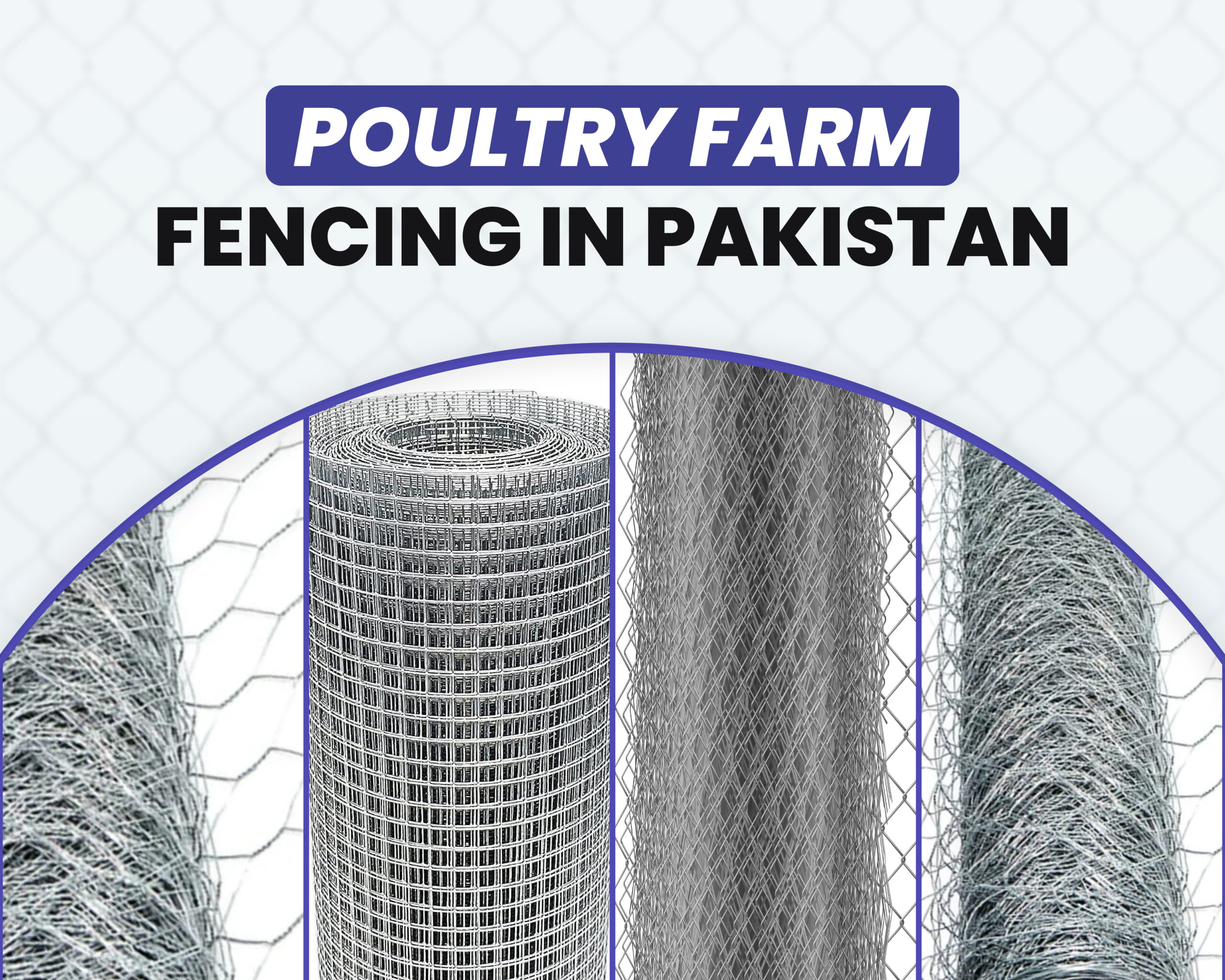
The poultry industry is one of the fastest-growing agricultural sectors in the country. From small backyard poultry units to large commercial broiler and layer farms, one challenge remains constant: protecting birds from predators while maintaining strict biosecurity. This is where Poultry Farm Fencing in Pakistan becomes not just important—but essential.
Choosing the wrong fencing material can lead to bird losses, disease risks, frequent repairs, and higher long-term costs. Choosing the right mesh, on the other hand, improves farm security, bird health, and operational efficiency.
In this in-depth guide, we will break down the three most commonly used fencing materials in poultry farms:
We’ll compare them based on predator control, biosecurity, durability, cost, and best-use scenarios—so you can confidently choose the right solution for Poultry Farm Fencing in Pakistan.
Why Poultry Farm Fencing Matters More Than Ever
Modern poultry farming is no longer just about feeding birds and managing sheds. It’s about loss prevention, disease control, and compliance with biosecurity standards.
A well-planned Poultry Farm Fencing in Pakistan helps to:
- Stop predators like dogs, foxes, cats, snakes, and rodents
- Prevent unauthorised human entry
- Control the movement of people, vehicles, and animals
- Reduce disease transmission from outside sources
- Protect feed storage and equipment
- Improve overall farm hygiene and management
Poor fencing is one of the most common causes of repeated losses in poultry farms across Pakistan—especially in rural and semi-urban areas.
Common Predator Threats to Poultry Farms in Pakistan
Before selecting fencing material, it’s important to understand what you’re protecting against. Predators vary by region, but the most common threats include:
- Stray dogs – the biggest threat to broiler farms
- Foxes and jackals – common near agricultural land
- Cats and mongooses – enter through weak or wide mesh
- Snakes – especially dangerous for chicks and eggs
- Rodents – not only predators but also disease carriers
- Wild birds – major biosecurity risk due to disease transmission
Effective Poultry Farm Fencing in Pakistan must address both physical predators and invisible biosecurity threats.
Key Factors to Consider When Choosing Poultry Fencing Mesh
Not all wire mesh is suitable for poultry farms. When evaluating options for Poultry Farm Fencing in Pakistan, consider these factors:
- Mesh opening size – determines what can enter or escape
- Wire thickness (gauge) – impacts strength and lifespan
- Flexibility vs rigidity – affects installation and durability
- Corrosion resistance – critical in humid and waste-heavy environments
- Ease of cleaning and maintenance – vital for biosecurity
- Cost vs long-term value – not just initial price
Now let’s compare the three most widely used mesh types in detail.
Chicken Wire Mesh for Poultry Farms
What is Chicken Wire Mesh?
Chicken wire mesh is made from thin galvanized steel wires twisted into a hexagonal pattern. It is lightweight and flexible, commonly used in small poultry setups.
Advantages of Chicken Wire Mesh
- Low initial cost
- Easy to cut, shape, and install
- Suitable for small poultry enclosures
- Widely available across Pakistan
Limitations
- Thin wire is easy to bend or tear
- Weak against dogs and foxes
- Shorter lifespan in harsh environments
- Poor resistance to repeated stress
Best Use Cases
Chicken wire works best for:
- Small backyard poultry units
- Internal partitions inside sheds
- Temporary fencing
- Protection of chicks inside controlled areas
While chicken wire is often the first choice due to price, it is not recommended as the main perimeter fencing for commercial Poultry Farm Fencing in Pakistan.
Hexagonal (Triple Twist) Mesh for Poultry Farms
What is Hexagonal Mesh?
Hexagonal triple twist mesh is a stronger version of chicken wire. The triple-twist design prevents unraveling even if one wire breaks, making it more durable and reliable.
Advantages of Hexagonal Mesh
- Stronger than standard chicken wire
- Flexible yet durable
- Better resistance to predators
- Long service life when galvanized or PVC coated
- Cost-effective for large farm boundaries
Biosecurity Benefits
- Smaller mesh sizes reduce wild bird entry
- Prevents snakes and rodents more effectively
- Easy to combine with ground skirts (buried fencing)
Best Use Cases
Hexagonal mesh is one of the most popular choices for Poultry Farm Fencing in Pakistan, especially for:
- Farm perimeter fencing
- Open-sided poultry sheds
- Free-range poultry systems
- Areas with moderate predator pressure
For most medium to large farms, galvanized hexagonal mesh offers the best balance between cost, strength, and biosecurity.
Welded Wire Mesh for Poultry Farms
What is Welded Wire Mesh?
Welded wire mesh is made by welding steel wires at each intersection, creating a rigid grid structure. It is much stronger than twisted wire meshes.
Advantages of Welded Wire Mesh
- Extremely strong and rigid
- Excellent predator resistance
- Long lifespan with proper galvanization
- Maintains shape under pressure
- Easy to clean and disinfect
Biosecurity Advantages
- Uniform openings reduce disease-carrying wildlife entry
- A smooth surface allows better sanitation
- Ideal for high-biosecurity zones
Limitations
- Higher upfront cost
- Less flexible, requires precise installation
- Heavier material compared to the hex mesh
Best Use Cases
Welded wire mesh is ideal for:
- High-value breeder farms
- Hatcheries
- Feed storage areas
- Quarantine zones
- Entry points and gates
For farms prioritizing maximum security and hygiene, welded wire mesh is often the premium choice in Poultry Farm Fencing in Pakistan.
Chicken Wire vs Hex Mesh vs Welded Wire Mesh (Quick Comparison)
| Feature | Chicken Wire | Hexagonal Mesh | Welded Wire Mesh |
|---|---|---|---|
| Strength | Low | Medium | High |
| Predator Resistance | Low | Good | Excellent |
| Biosecurity | Basic | Good | Excellent |
| Lifespan | Short | Medium–Long | Long |
| Cost | Low | Medium | Higher |
| Best Use | Small/temporary | Perimeter fencing | High-security areas |
Biosecurity: The Hidden Benefit of Proper Poultry Fencing
Biosecurity is not just about disinfectants and footbaths. Poultry Farm Fencing in Pakistan plays a critical role in disease prevention.
Good fencing helps:
- Control the movement of people and vehicles
- Prevent contact with wild birds
- Reduce rodent infestation
- Maintain controlled entry points
When fencing is weak, farms are exposed to diseases like avian influenza, Newcastle disease, and bacterial infections—all of which can cause massive losses.
Installation Tips for Poultry Farm Fencing
Even the best mesh will fail if installed incorrectly. For effective Poultry Farm Fencing in Pakistan, follow these tips:
- Use strong fence posts with proper spacing
- Bury mesh at least 6–12 inches to stop digging predators
- Use concrete footings for corner and gate posts
- Avoid gaps at the bottom or around gates
- Combine fencing with barbed wire or electric wire where needed
- Regularly inspect and repair damaged sections
A properly installed fence can double the effective lifespan of your mesh.
Cost vs Long-Term Value: What Should Farmers Choose?
Many farmers choose fencing based only on initial price. However, repeated bird losses and repairs quickly make cheap fencing expensive.
For Poultry Farm Fencing in Pakistan:
- Chicken wire = lowest upfront cost, highest risk
- Hexagonal mesh = best overall value for most farms
- Welded wire mesh = higher cost, lowest long-term risk
Smart farm owners calculate the total cost over 5–10 years, not just the purchase price.
Recommended Fencing Strategy for Poultry Farms
For most commercial farms, the best approach is a combination strategy:
- Perimeter fencing: Galvanized hexagonal mesh
- High-risk zones & gates: Welded wire mesh
- Internal partitions: Chicken wire or lighter mesh
- Top security (if needed): Barbed wire or electric wire
This layered approach delivers strong predator control, better biosecurity, and cost efficiency—making it ideal for Poultry Farm Fencing in Pakistan.
Final Thoughts
Choosing the right mesh is one of the most important decisions a poultry farmer can make. The right fencing protects your birds, your investment, and your peace of mind.
Whether you run a small poultry unit or a large commercial operation, investing in the correct Poultry Farm Fencing in Pakistan solution will reduce losses, improve biosecurity, and support long-term farm success.
If you’re serious about poultry farming, don’t treat fencing as an afterthought—treat it as a core part of your production system.
